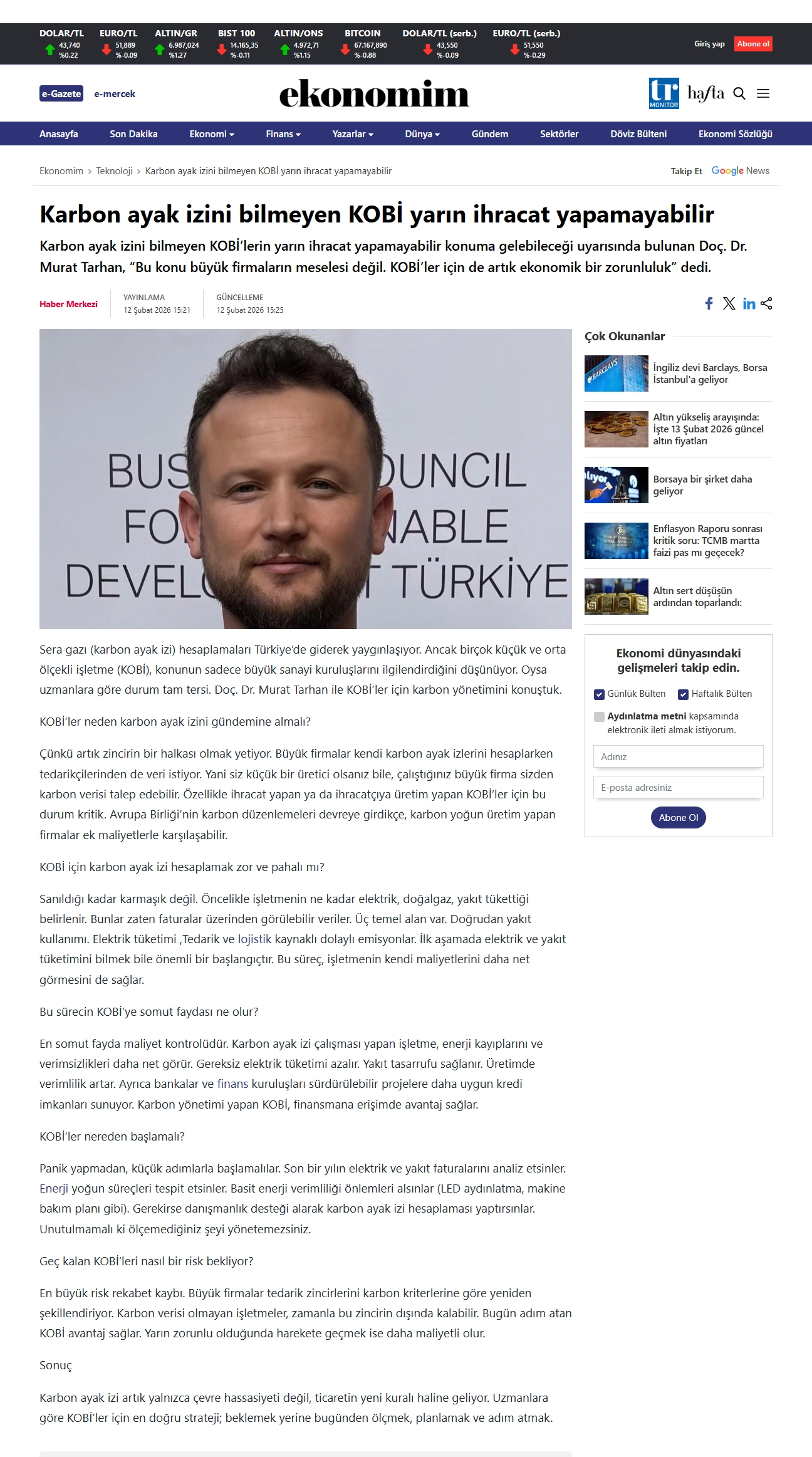
Greenhouse gas (carbon footprint) calculations are becoming increasingly common in Turkey. However, many small and medium-sized enterprises (SMEs) think that the issue concerns only large industrial organisations. However, according to experts, the situation is quite the opposite. We talked to Assoc. Prof. Dr. Murat Tarhan about carbon management for SMEs.
Why should SMEs put carbon footprint on their agenda?
Because now it is enough to be a link in the chain. While large companies calculate their carbon footprints, they also request data from their suppliers. So even if you are a small manufacturer, the big company you work with may request carbon data from you. This is especially critical for SMEs that export or produce for exporters. As the European Union's carbon regulations come into effect, companies engaged in carbon-intensive production may face additional costs.
Is it difficult and expensive to calculate carbon footprint for SME?
It is not as complicated as it seems. Firstly, it is determined how much electricity, natural gas and fuel the enterprise consumes. These are already visible data on invoices. There are three main areas. Direct fuel use. Electricity consumption, indirect emissions from supply and logistics. Even knowing the electricity and fuel consumption at the first stage is an important start. This process also allows the business to see its own costs more clearly.
What is the concrete benefit of this process for SMEs?
The most tangible benefit is cost control. The enterprise, which performs carbon footprint studies, sees energy losses and inefficiencies more clearly. Unnecessary electricity consumption is reduced. Fuel savings are achieved. Efficiency in production increases. In addition, banks and financial institutions offer more favourable credit opportunities for sustainable projects. The SME that manages carbon provides an advantage in access to finance.
Where should SMEs start?
They should start with small steps without panicking. Analyse their electricity and fuel bills for the last year. Identify energy-intensive processes. Take simple energy efficiency measures (such as LED lighting, machine maintenance plan). If necessary, they should get consultancy support and have their carbon footprint calculated. It should not be forgotten that you cannot manage what you cannot measure.
What kind of risk awaits late SMEs?
The biggest risk is loss of competition. Large companies are reshaping their supply chains according to carbon criteria. Businesses without carbon data may be excluded from this chain over time. The SME that takes a step today gains an advantage. It will be more costly to take action tomorrow when it is mandatory.
Conclusion
Carbon footprint is becoming not only an environmental sensitivity but also the new rule of trade. According to experts, the best strategy for SMEs is to measure, plan and take steps today instead of waiting.